Sitting in front of a MacBook with the perfect text compose, corrected and amplified — and for want of an at sign the email was not sent? Find out here how to type the ‘at’ symbol ( @ ) on a Mac keyboard ⤓ (even using a different language and layout), and how to produce the small and full-width at signs, too.
On This Page
How to Type the ‘At’ Symbol ( @ ) on a Mac
Time needed: 1 minute
To enter the ‘at’ symbol ( @ ), say to make an email address, using the keyboard on a Mac:
- Position the text cursor where you want to insert the ‘at’ symbol (commercial at).
Here’s where: The @ sign is often employed without whitespace, e.g., in the middle of email addresses, where it separates the user name from the domain; if you address someone, use the @ symbol immediately before the addressee.
Examples: Email address heinz@ladedu.com; mentioning someone @ladedu. - Press Shift 2.
Other keyboard layouts: The key combination above works on US-English Mac keyboards; for other layouts, see below to find the key combination for typing ‘@’.
A rounder @: For a version of the at sign that typically resembles a circle more closely (at the expense of taking up more horizontal space), you can try the full-width @; see below.
@ your fingers’ tips?
Tips help fuel these email and tech how-tos.
Find the @ Symbol Key Combination for Your Keyboard Layout
To discover the key combination to use for inserting the at symbol on your keyboard:
- Open Mac Keyboard Viewer.
- Look for the @ symbol on a key itself.
Found it: Press the corresponding key to insert ‘@’.
Example: On a Norwegian keyboard, press @ for the at sign. - Look for @ in the top left corner of a key.
Found it: Press Shift together with the key to insert the at symbol.
Example: Press Shift 2 for @ on a Greek keyboard. - Hold the Option key.
- Look for the @ symbol on a key itself.
Found it: Press the corresponding key together with Option to insert ‘@’.
Example: On a German-language keyboard, press Option L for the at sign. - Look for @ in the top left corner of a key.
Found it: Press Shift and Option together with the key to insert the @ sign.
Example: Press Option Shift ૨ for @ on a Gujarati keyboard.
Their word: Apple include information on using Keyboard Viewer in the Mac User Guide.
Insert the @ Symbol Using Mac Character Viewer
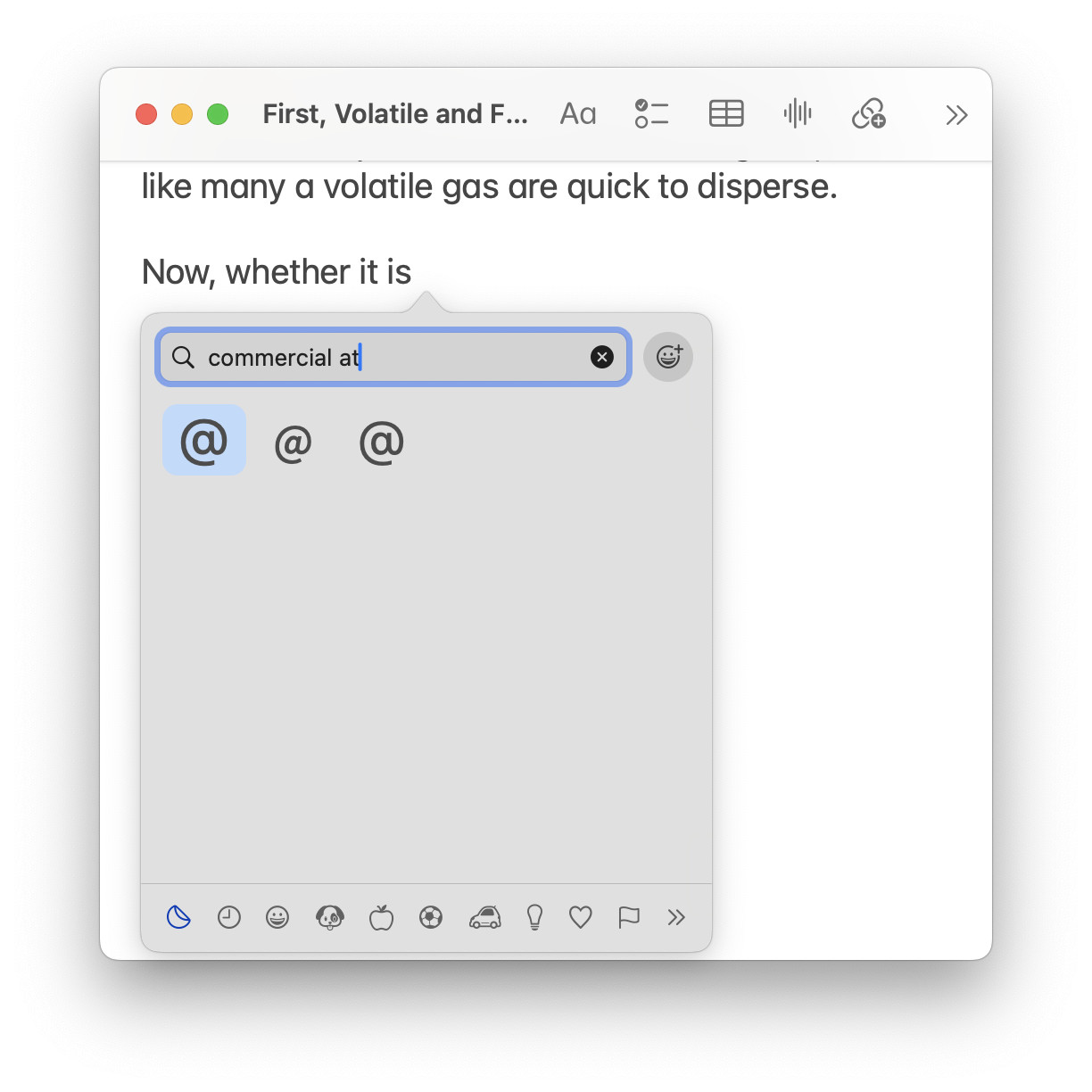
To use Character Viewer or the emoji pane to input the at sign on a Mac:
- Position the text insertion cursor where you want to place the @ symbol.
- Open Character Viewer or the emoji pane.
Here’s how: Select Edit | Emoji & Symbols, for example, from the menu.
Mac keyboard shortcut: You can also press 🌐︎ or Fn E to open the emoji panel or Character Viewer. - Type
commercial atin the Search field. - Double-click the desired ‘at’ symbol in search results to insert it.
How to Type the ‘at’ Symbol (@) on a Mac: FAQ
Can I copy the ‘at’ symbol for pasting?
Yes.
Use the table below to copy the desired commercial at sign for pasting anywhere:
‘at’ symbol @ |
small ‘at’ symbol ﹫ | |
full-width ‘at’ symbol @ |
Is it safe to use the full-width @ in an email address?
No.
Email addresses require the regular at symbol @ to function.
Can I insert the @ sign directly using its Unicode code point?
Yes.
To input the @ sign directly using Unicode on a Mac:
- Enable and switch to Unicode Hex Input.
- Press and hold Option.
- Now type 0 0 4 0 for @.
More ‘at’s: Type F E 6 B for the small at ( ﹫ ) and F F 2 0 for the full-width at ( @ ). - Let go of the Option key.
‘At’ Symbol Key Combinations
| Language | @ Symbol Key Combination |
|---|---|
| English | Shift 2 |
| Albanian | @ |
| Arabic | Shift ٢ |
| Bengali | Shift ২ |
| Bulgarian | Option Shift 2 |
| Croatian | Option 2 |
| Czech | Option ě |
| Danish | Option ' |
| Devanagari | Option Shift २ |
| Dutch | Shift 2 |
| Belgian | @ |
| Estonian | Option 2 |
| Faroese | Option ' |
| Finnish | Option 2 |
| French | @ |
| French (Canada) | Option 2 |
| French (Switzerland) | Option G |
| Georgian | Shift 2 |
| German | Option L |
| German (Switzerland) | Option G |
| Greek | Shift 2 |
| Gujarati | Option Shift ૨ |
| Hawaiian | Shift 2 |
| Hebrew | Shift 2 |
| Hindi | Option Shift २ |
| Hungarian | Option Q |
| Icelandic | Option 2 (or Option Q) |
| Inuktitut | Shift 2 |
| Irish | Shift 2 |
| Italian | Option Ò |
| Kazakh | Option Shift Ә |
| Khmer | Option ៗ |
| Korean | Shift 2 |
| Kurdish | Option Q |
| Kyrgyz | Option 2 |
| Latvian | Shift 2 |
| Macedonian | Option 2 |
| Maithili | Shift २ |
| Malayalam | Shift ൨ |
| Maltese | Shift 2 |
| Maori | Shift 2 |
| Marathi | Option Shift २ |
| Mongolian | Option - |
| Nepali | Shift २ |
| Norwegian | @ |
| Odia | Shift ୨ |
| Pashto | Shift ۲ |
| Persian | Shift ۲ |
| Polish | Option 2 |
| Portuguese | Option 2 |
| Portuguese (Brazil) | Shift 2 |
| Punjabi | Shift ੨ |
| Romaji | Shift 2 |
| Romanian | Shift 2 |
| Russian | Option 2 |
| Sanskrit | Option Shift २ |
| Santali | Shift ᱒ |
| Sami | Option Đ |
| Serbian | Option Shift 2 |
| Sindhi | Option ۲ |
| Sinhala | Shift 2 |
| Slovak | Option ľ |
| Slovenian | Option Shift 2 |
| Spanish | Option G |
| Spanish (Latin America) | Option Q |
| Swedish | Option ' |
| Tajik | Option 2 |
| Tamil | Shift 2 |
| Telugu | Shift ౨ |
| Tongan | Shift 2 |
| Turkish | Option F (or Option Q) |
| Turkmen | Shift 2 |
| Ukrainian | Option 2 |
| Uyghur | Shift 2 |
| Uzbek (Cyrillic) | Option 2 |
| Vietnamese | Option Shift  |
| Vietnamese (Telex) | Option L |
| Welsh | Shift 2 |
(Tested with macOS Tahoe 26 and Sequoia 15; first published March 2025, last updated August 2026)