
Struggling to enter a special character or quote text in an ancient script on your Windows PC? Wondering whether — and how — you can produce all the characters of Unicode? Find out here how to type any Unicode character on Windows 11 and Windows 10 ⤓ (in any application).
On This Page
How to Type Any Unicode Character on Windows 10 and 11
⚡ Quick Fix
Type the UTF-32 hex code for the character from Unicode in Notepad, then press Alt X immediately afterwards.
Time needed: 3 minutes
To type any Unicode character in Windows using an easy and fast method:
- Open a new document in Microsoft Word.
No Word: If you do not have Word installed, do use Notepad or WordPad instead (see below for adding WordPad to Windows 10 and Windows 11 up to Version 24H2); these are the only ways that let you enter Unicode characters by code without endless headache or typing fumblingly.
- Type the UTF-32 hexadecimal code for the character you want to enter.
No prefixes: Do not add anything in front (such as
U+or\u).
Example: Enter1F6A0for a mountain cableway.
- Press Alt X immediately.
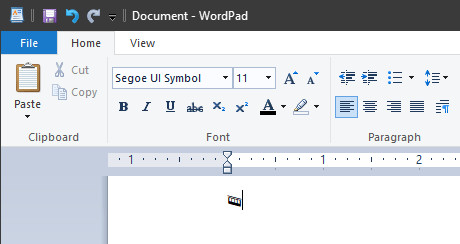
- Highlight the Unicode character you just created.
- Press Ctrl C to copy the character.
- Paste it where you want to input the Unicode char.
Keyboard shortcut: Press Ctrl V to paste.
Gladly glyph-ing?
Tips help fuel these email and tech how-tos.
Input Unicode Characters Using NumPad Alt-Codes in Windows
To enter Unicode characters using the keyboard anywhere in Windows:
- Position the text cursor where you want to enter the character.
- Press and hold Alt.
- Now press the + key on the numeric keypad.
- Enter the hexadecimal UTF-32 code for the desired Unicode character.
- Release the Alt key.
Nothing appears: Entering Unicode characters may be disabled in your Windows registry; see below.
Type a Unicode Character Using a Third-Party Windows Utility
Using the free, lightweight and eminently useful UnicodeInput, you can enter Unicode characters by UTF-32 code anywhere in Windows with ease.
Enter Unicode Symbols Using Emoji Panel
For many a Unicode character and symbol, you can also turn to the Windows emoji panel:
- Press Windows . (period).
- Go to the Symbols tab (%⟳△+).
Windows 10: The symbols tab is denoted with Ω. - Pick the Unicode character you want to insert.
How to Type Any Unicode Character on Windows: FAQ
“Alt +” does not work to enter Unicode characters by value; what can I do?
Most likely, hexadecimal Unicode input is not enabled in the Windows registry.
To have Windows allow you to enter hex codes for Unicode:
- Download unzip and install the following reg file: EnableHexNumpad.reg.zip (MD5 checksum: 58f00bf581e473866f767e5b36244c06).
Caution: This is slightly dangerous, and I would advise you not to install registry files you have not created yourself. Do examine the file in a plain text editor such as notepad first and do verify its MD5 checksum.
The file should contain nothing but the following:
Windows Registry Editor Version 5.00
 [HKEY_CURRENT_USER\Control Panel\Input Method]
 "EnableHexNumpad"="1"
How can I install WordPad on Windows 11 or Windows 10?
To add WordPad to Windows for easy Alt X Unicode character input:
Important: In Windows 11 Version 24H2 and later, WordPad is no longer available for installing.
- Open Windows settings.
Windows keyboard shortcut: Press Windows I to open settings. - Go to the System category.
Windows 10: Go to Apps instead. - Select Optional features.
- Now click View features or Add a feature.
- Check WordPad.
- Now click Next followed by Add (or Install).
(Tested with Windows 11 Version 22H2–25H2 and Windows 10 Version 21H1; first published June 2021, last updated October 2026)