

Suspect mischief behind a domain name? Need to look up the IP address for a domain name for troubleshooting? Want to find both the IPv4 and the IPv6 address to which a domain name resolves? Find out here how to find the IP address (IPv4 and IPv6) for a domain ⤓ on Windows, Mac, Linux and the web.
On This Page
How to Find the IP Address for a Domain (IPv4 and IPv6)
⚡ Quick Fix
Windows: nslookup domain.com
Mac/Linux: dig +short domain.com
Look at A records for IPv4 and AAAA records for IPv6 addresses.
Using a Command-Line Tool on Windows, Mac and Linux
Time needed: 3 minutes
To find the IPv4 and IPv6 IP address for a domain on a Windows, Mac and Linux computer:
- Open the terminal or command line for your operating system.
Mac: Open the Terminal app.
Windows: Open PowerShell or Command Prompt in the Windows Start menu (you can press Windows R and runcmdto open command prompt).
Linux: Open a terminal application.
No terminal: See below for looking up the IP address for a domain using a web service. - Enter the appropriate command for looking up a domain’s IP address.
Windows: Type
nslookup -q=A+AAAA <domain>.
Mac and Linux: Typedig +short <domain> A <domain> AAAA.
The domain: Replace <domain> with the domain whose IP address you want to look up.
Versions of IP: This looks up both IPv4 and IPv6; not all domains have both addresses associated — see below for looking up just one or the other.
Example: Usedig +short ladedu.com A ladedu.com AAAAto look up the IPv4 and IPv6 address for ladedu.com on a Mac.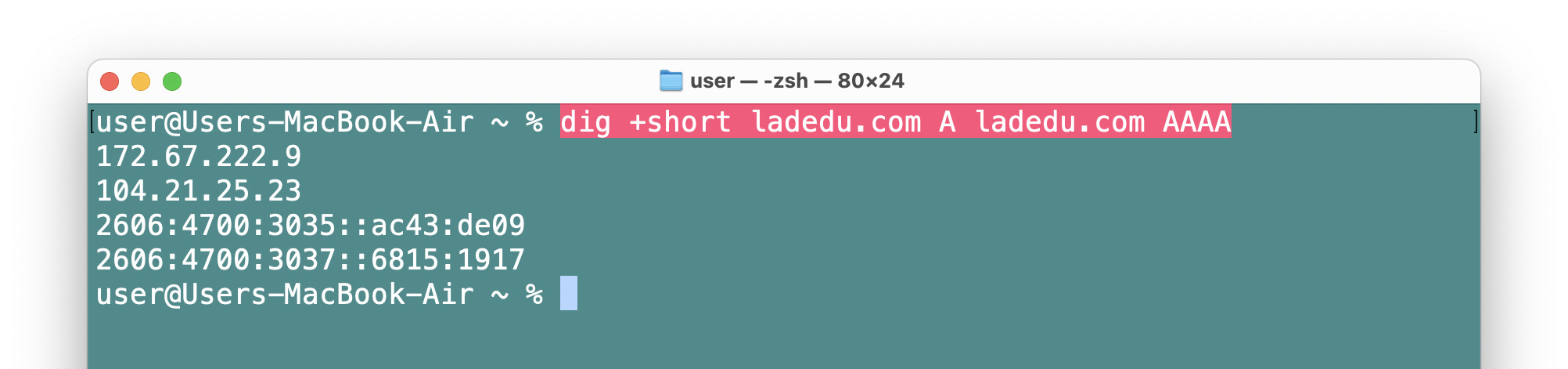
- Press Enter.
- Find the IP addresses listed as a result.
IP: “IP” stands for “Internet Protocol” and defines how data is transferred across the network between hosts, which are identified with addresses, the IP addresses.
IPv4: DNS A records list the (traditional) IPv4 address to which the domain name resolves; its format is [0-255].[0-255].[0-255].[0-255], e.g., 172.67.222.9.
IPv6: The DNS AAAA (“Quad-A”) record is the equivalent to A records for IPv6 addresses to which the domain name can resolve as well; the format is the vastly longer [0x0000–0xFFFF]:[0x0000–0xFFFF]:[0x0000–0xFFFF]:[0x0000–0xFFFF]:[0x0000–0xFFFF]:[0x0000–0xFFFF]:[0x0000–0xFFFF]:[0x0000–0xFFFF] (eight segments of 16-bit values each ranging from 0 to hexadecimal FFFF (65535 in decimal), e.g., 2606:4700:3035:0000:0000:0000:AC43:DE09.
Multiple addresses: A domain resolving to multiple addresses is normal; many websites use load balancing, content delivery networks or servers geographically spread.
Proxies: If a domain uses a CDN (such as Bunny.net or Cloudflare), the IP addresses returned may belong to that service rather than the site’s original server.
Their word: The ISC include information on dig and its options in the dig manual.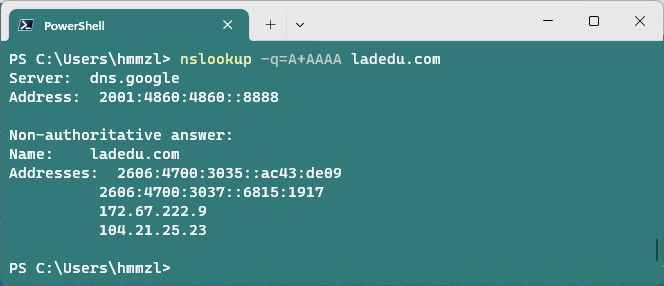
Dig-ed this?
Tips help fuel these email and tech how-tos.
Find the IP Address for a Domain on the Web
To establish the IP addresses for any domain using a browser:
- Visit NsLookup-io (or an alternative) in your favorite browser.
Alternatives: Some other pages to look up IP addresses include MX Toolbox, DNS Checker and Whatsmydns.net. - Look for A and AAAA records in the results.
What it looks like: See above for the format of IP addresses.
More in DNS for email security: How to Check the SPF Email Records on a Domain
How to Find the IP Address for a Domain: FAQ
What does “::” mean in an IPv6 address?
In an IPv6 address, 0000 can be omitted, the two colons remaining; a series of three colons can also be replaced with two.
Example: 2606:4700:3035:0000:0000:0000:AC43:DE09 is equivalent to 2606:4700:3035::AC43:DE09.
Can I look up both IPv4 and IPv6 with “dig” without repeating the domain?
Yes.
You can add the following function to your shell .rc file (such as ~/.zshrc or ~/.bashrc,) to add the digas command, which will return both A and AAAA records for a domain.
#!/bin/sh
#
# ladedu_digas.sh
#
# Looks up both A (IPv4) and AAAA (IPv6) records for a domain using dig.
#
# (c) Heinz Tschabitscher 2024
# https://ladedu.com/how-to-find-the-ip-address-for-a-domain/

digas() {
  if [ -z "$1" ]; then
    echo "Usage: digas <domain>"
  else
    dig +noall +answer A "$1" AAAA "$1"
  fi
}
The function is also available as the ladedu_digas.sh file, which you can include using the source command in your shell’s rc file.
Alternative: You can also use the digall shell script, of course.
Are there graphical DNS lookup tools?
Yes.
On Windows, you can try DNSDataView, for example.
(Tested with Windows 11 Version 22H2–25H2, macOS Tahoe 26 and Sonoma 14 as well as Fedora Linux 38; first published October 2023, last updated September 2026)